

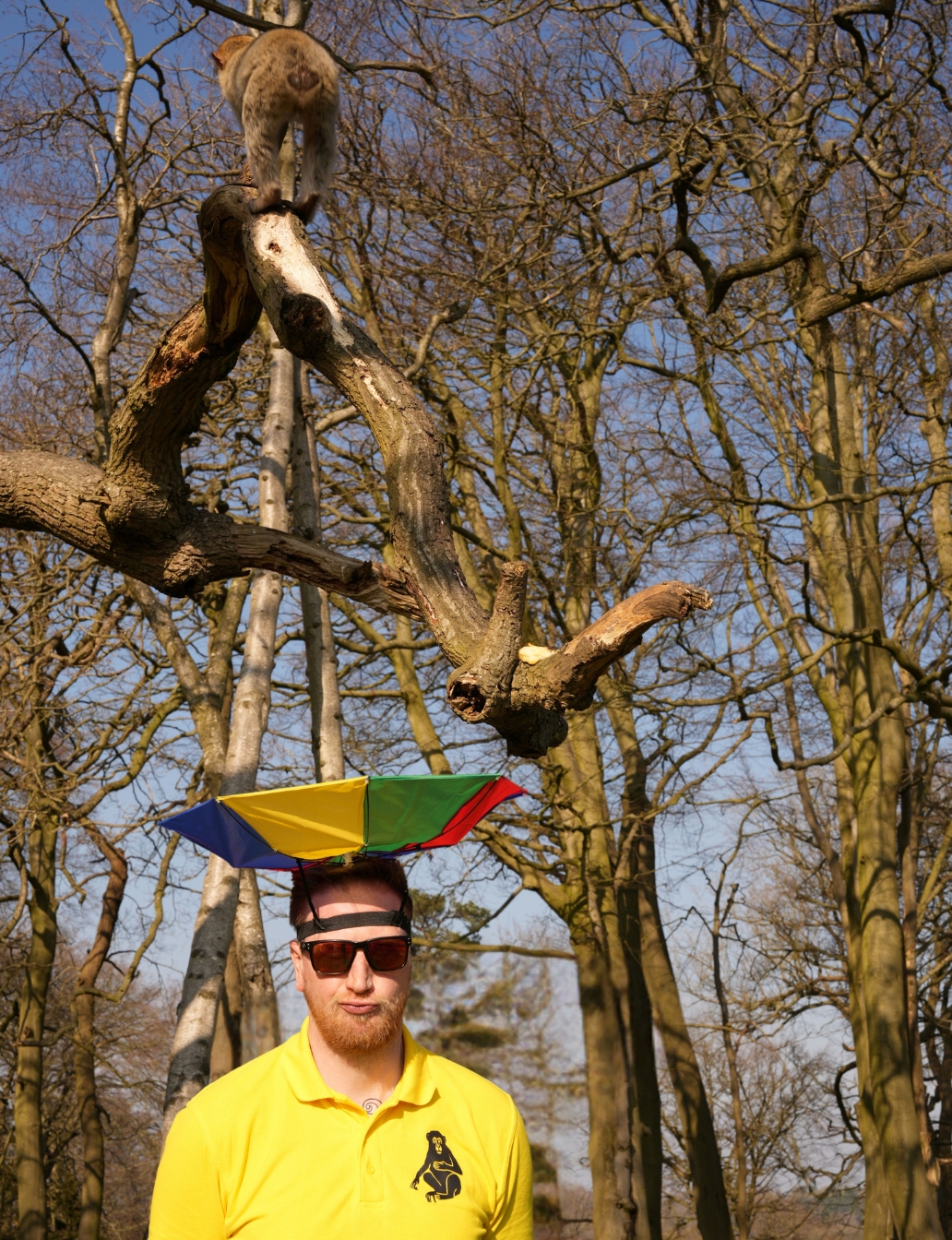
In a world-first for primate research (and questionable fashion choices), the UK’s only Monkey Forest is delighted to unveil a new tool in the battle for scientific discovery: monkey poo-catching umbrella hats for its dedicated team of conservationists.
Yes, you heard that right. Monkey poo-catching umbrella hats!
The hardworking guides have (supposedly) taken a bold step forward in primatology by donning special headgear designed to catch falling macaque droppings for vital gut health research. After all, when it comes to science, you must get your hands— or, in this case, your hats—dirty.
The park took to its social media channels to confirm the bizarre new strategy, alongside some pictures of the hats in action!
But before you start feeling too sorry for them, let’s address the obvious … April Fools!
While the guides won’t be wearing poo-catching hats (thankfully for them), the science behind the park’s monkey business is very real.
The Trentham Monkey Forest team does collect macaque poo (by more traditional, less hat-based methods) to assist researchers in studying gut health and the overall well-being of the incredible Barbary macaques.
“While we’d love to see our team rock some stylish umbrella headwear, the reality is a little less comedic but far more important,” said Matt Lovatt the Park Director at Trentham Monkey Forest. “By analysing monkey poo, we help contribute to vital research that aids in the conservation and health of our beloved Barbary macaques.
So, while our guides may not be dodging falling ‘samples’ with strategically placed umbrellas, they’re still playing a crucial role in helping us understand and protect this fascinating species. We’ll leave the umbrella hats for British weather— and keep the monkey business strictly scientific!”
In 2024, the park helped researcher Matt Gardiner, the PhD student from Liverpool John Moore’s University, decode the secrets hidden in monkey poo.
Matt collected monkey faeces in the Staffordshire Woodland to trial a new measure of gut health analysis. Matt then travelled to Morocco in April 2024 and used the techniques he practised at Trentham Monkey Forest- to conduct the same studies on wild Barbary macaques.
Matt used Fourier-Transform Infrared spectrometry a cutting-edge method in measuring the faecal glucocorticoid concentrations in primates. It is hoped that this new analysis can then be used more widely with other primates.
The levels of faecal glucocorticoids can spill the beans on a monkey’s well-being. Matt was able to perfect his method in Staffordshire, before venturing out to Morocco to analyse the gut health of monkeys in the wild.
Trentham Monkey Forest is the largest primate space in the UK. Covering 60-acres, which is the equivalent of around 40 football pitches, the Staffordshire woodland is home to 140 free-roaming Barbary macaque monkeys.
The monkeys live remarkably similar lives to those in the wild, and visitors can observe their natural behaviours up close in the habitat they call home all year round.
Barbary macaques are an endangered species, with less than 8,000 thought to be remaining in the wild. The macaques play a key role in widening the biodiversity of their habitat through the dispersal of seeds through their poo.
For more information on the park’s real conservation efforts (and to see our guides not wearing umbrella hats), visit www.monkey-forest.com or follow the park on social media.