








Residents across Levedale, Penkridge, Dunston and the surrounding villages say their peaceful corner of Staffordshire is being transformed beyond recognition. Two vast solar farms and a large battery storage compound are set to dominate the landscape, bringing fears for road safety, wildlife and the loss of open farmland.
The schemes, stretching from Butterhill at one end of Levedale Road to Preston Hill at the other, will together cover hundreds of acres of countryside. Between them, a battery energy storage facility is also proposed near Longridge. Locals say the combined impact will turn their countryside into an industrial corridor and destroy the rural character that generations have fought to preserve.
A Quiet Country Lane at Risk
Levedale Road, a narrow country lane linking Penkridge to Bradley, has become the focus of deep concern. It is less than six metres wide in most sections, has high hedgerows, sharp bends and long stretches with no pavement. It is used daily by farmers, horse riders, cyclists and schoolchildren.
Independent highways consultant Roy Middleton, who was commissioned by local residents to assess the road before the Preston Hill solar farm was approved, described it as “wholly unsuited” to the volume of heavy traffic that construction would bring. His report recorded carriageway widths as narrow as 4.9 metres, tight bends and verges already scarred by passing vehicles.
Mr Middleton warned that any increase in heavy goods movements “has the potential for serious injury or even fatality” along the stretch between the railway bridge and Preston Vale Lane. He said articulated lorries would struggle to negotiate bends safely, and that the required visibility at the site entrance could only be achieved by removing mature trees and hedgerows. His professional recommendation was clear: the application should be refused on highway safety grounds.
Two Major Solar Schemes on One Country Road
The Preston Hill Solar Farm, approved by South Staffordshire Council earlier this year, will generate up to 49.9 megawatts of power, with rows of panels covering large sections of farmland. The developer, Aura Power, says the project will power around 14,000 homes and contribute £100,000 in business rates each year.
At the other end of the same road, the Butterhill and Coppenhall solar farm is also moving forward, adding to the pressure on Levedale Road and its narrow connecting lanes. Between the two is the proposed Battery Energy Storage System, which would install dozens of industrial battery containers capable of storing and releasing electricity back into the grid. Residents fear the combined impact of all three schemes will transform the area into an industrial landscape.
Not Against Renewables, But Against Overdevelopment
Residents stress that they support renewable energy in principle and that several of them already have solar panels and other renewable systems installed on their own homes. However, they believe that South Staffordshire’s rural infrastructure cannot cope with such large schemes concentrated in one location.
“We are not anti-green energy,” said one local resident who has lived in the area for more than twenty years. “Indeed, many of us have solar panels on our own houses. We are simply against unsuitable industrial development on rural lanes that were never designed for heavy traffic. It is about common sense and safety.”
Concerns About Process and Consultation
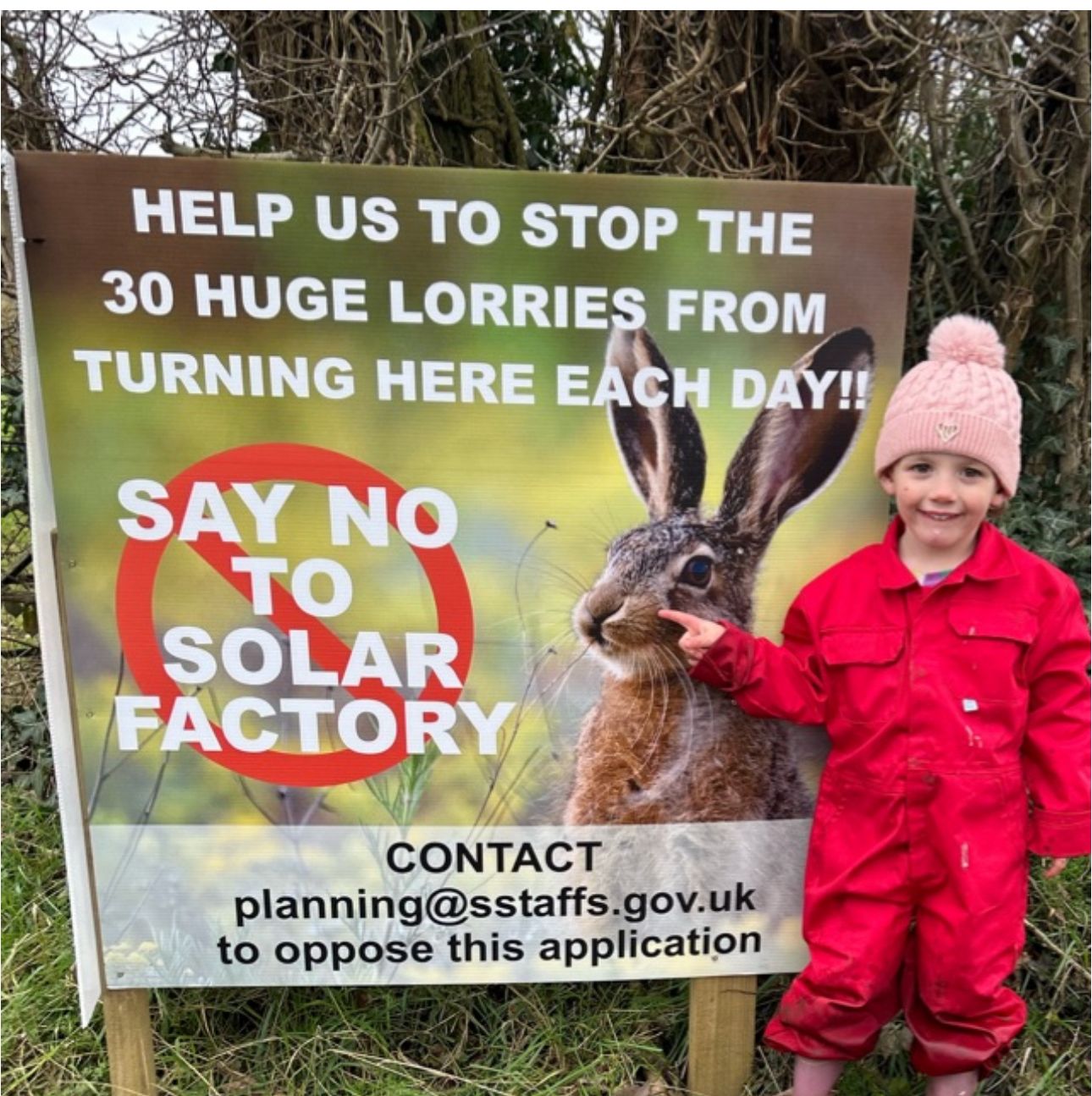
Many residents lodged detailed objections, raising concerns about safety, loss of farmland, flooding and harm to wildlife. Others say they only learned of the plans after planning notices were placed on the opposite side of the road, making them easy to miss. Despite the independent highways report and strong local opposition, the county highways authority raised no objection, and the scheme was approved by councillors.
Following the decision, KMC Legal and Finance, representing a group of affected households, lodged formal complaints with South Staffordshire Council, alleging poor consultation and inadequate consideration of road safety. While the council acknowledged some communication issues, it maintained that all statutory procedures had been followed.
Plans for a judicial review of the decision were placed on hold in the early summer of 2025 after one of the key residents, one of the closest neighbours to the proposed sites, suffered a serious and life-threatening accident. The incident deeply affected the community, which rallied to support her recovery.
Now, almost a year later, residents say awareness of the plans remains worryingly low. Many people living in nearby villages are only now discovering the scale of what has been approved.
A Countryside Full of Life
Levedale and its neighbouring hamlets are known for their rolling farmland, ancient hedgerows and thriving wildlife. Birds, foxes, badgers and hares are regularly seen, along with birds of prey and songbirds that nest in the trees lining the fields. Cattle and horses graze the pastures, and the road itself is often used by riders and walkers.
Residents fear that the arrival of industrial energy infrastructure will drive wildlife away and replace the sounds of nature with the noise of construction and machinery.
As one resident put it:
“Levedale Road is a place where you can hear birds, horses and cows. It has been a wonderful place for me to grow up, and now my grandchild is growing up here too. We are in absolute fear that we are going to lose our peace and lose this part of the countryside.”
A Call for Common Sense
Campaigners are urging a pause and a full review of all energy projects along the Levedale corridor, taking into account their combined effects on traffic, the environment and rural life.
“There is a bigger picture here,” said another resident. “You have two solar farms and a huge battery site all feeding into the same grid. We want renewable energy, but not at the cost of people’s safety or the destruction of the countryside.”