









The measurements were right. The sofa was two seventy wide, the room takes two seventy five, and the delivery team stood in our hall for twenty minutes working out that the problem was not the room at all. It was the turn at the bottom of the stairs, which is Victorian, and which has been there rather longer than the sofa.
They took it away again. We paid the restocking fee, which was fair, and I learned something that anybody living in an older house works out eventually: furniture is designed for modern rooms, and our houses are not modern rooms.
What older houses do differently
Ceiling heights swing wildly. A Victorian front room can be generous and the bedroom above it low enough that a tall wardrobe will not stand up.
Walls are rarely straight. A bookcase that fits on paper meets a wall that bows, and the gap at one end is a centimetre and at the other end is four.
Bays are the recurring problem. They look like extra space and they are mostly unusable by rectangular furniture, and every bay has a different angle.
Then there are the fixed obstacles: chimney breasts, radiators under windows, picture rails that stop a wall unit going tight, skirting deep enough to hold a wardrobe an inch off the wall.
None of these appear in the product photograph, because the product photograph was taken in a room without any of them.
The measurements worth taking before you order
The route, not the room. Front door width, hall width, the turn at the stairs, the doorway into the room. The tightest point governs.
Ceiling height where the piece stands, not the height in the middle of the room.
Radiator depth and position, because a sofa pushed to the wall stops at the radiator, not at the plaster.
Skirting depth, which decides whether anything sits flush.
The bay angles, if you are hoping to put something in one. Most are not ninety degrees and no standard piece will fit tightly.
Write them on your phone and take them shopping. It sounds fussy. It is cheaper than a restocking fee.
Why brand imagery does not answer these questions
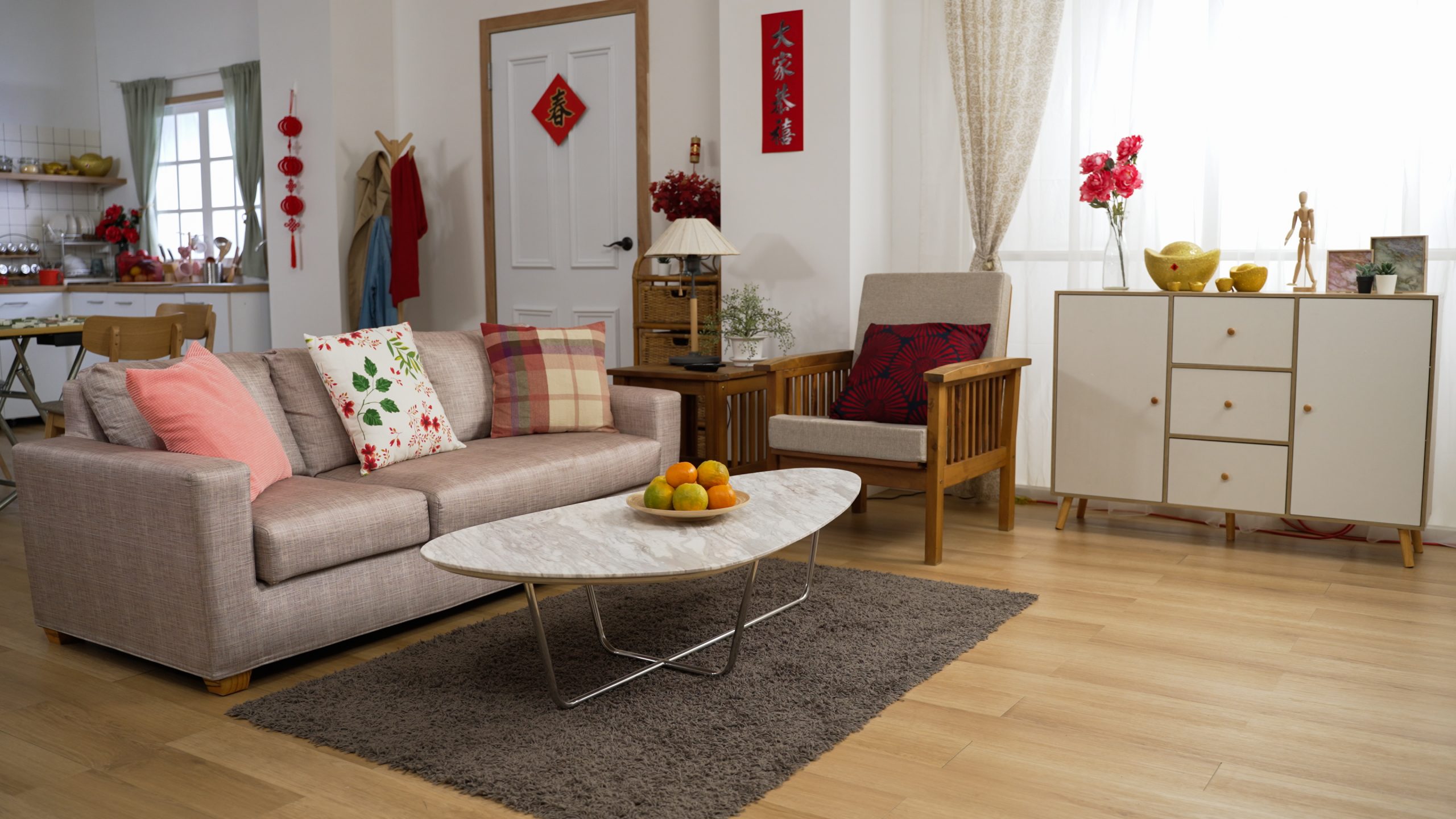
Furniture photography, and increasingly furniture visualisation, which is the same thing produced in 3D rather than a studio, is built to show the product at its best.
That means a generous room, a high ceiling, a clean wall and light from a big window. It is an accurate picture of the piece and a fictional picture of the setting, and the setting is doing a lot of quiet work.
What it does get right is the product itself. A modelled sofa is built from the manufacturing file, so the dimensions in the listing are the dimensions of the thing. The arm thickness, the seat depth, the leg height are all real. Those are the numbers to trust and the room around them is the part to ignore.
Some retailers now offer a room planner where you enter your own dimensions. Those are genuinely useful for the fit question, if you enter the awkward bits rather than an idealised rectangle.
Scale in a low ceilinged room
The other period house problem is proportion rather than fit.
Contemporary furniture is designed for rooms with higher ceilings than most older houses have upstairs, and tall pieces in a low room make the ceiling feel lower still. Low slung seating and pieces on legs give you back the floor visually, which matters more in a small room than any colour decision.
Wardrobes are the worst case. Measure the diagonal as well as the height, because a wardrobe has to be tilted upright once it is in the room, and a piece that fits standing may not fit going up.
A short checklist before you commit
Measure the route as well as the room. Check the ceiling height at the spot. Note the radiator and the skirting. Photograph the wall and hold the listing photograph next to it, so you are comparing your wall rather than the one in the picture. Ask the retailer whether the piece comes apart for delivery, because plenty do and nobody mentions it.
And ask what happens if it does not fit. Restocking fees vary enormously and a shop that waives them for a genuine access problem is worth paying slightly more to.
Buying secondhand for an older house
There is an argument for looking at older furniture in an older house, and it is practical rather than sentimental.
Pieces made before the war were built for rooms like yours. Wardrobes come apart because they had to go up narrow stairs. Sideboards are shallower than modern ones because the rooms were smaller. Chairs sit lower, which suits a lower ceiling.
The trade is condition and delivery. A Victorian wardrobe that comes apart into five pieces will get into your bedroom where a modern flat pack one will not, but somebody has to carry it and the veneer may need work.
Local auction houses across the county sell this sort of thing weekly, often for less than a mid range flat pack equivalent, and the fit problem largely disappears.
The compromise nobody regrets
For anything built in, a local maker will cost more than a flat pack unit and will build to the wall that exists rather than the wall that should exist.
In a house where nothing is square, that is often the cheaper answer once you count the fillers, the scribing and the afternoon somebody spends trying to make a straight cabinet meet a bowed wall.
Our sofa, in the end, was a two piece design that came through the hall in halves. It has been there four years and the hall corner remains undefeated.